Episode Transcript
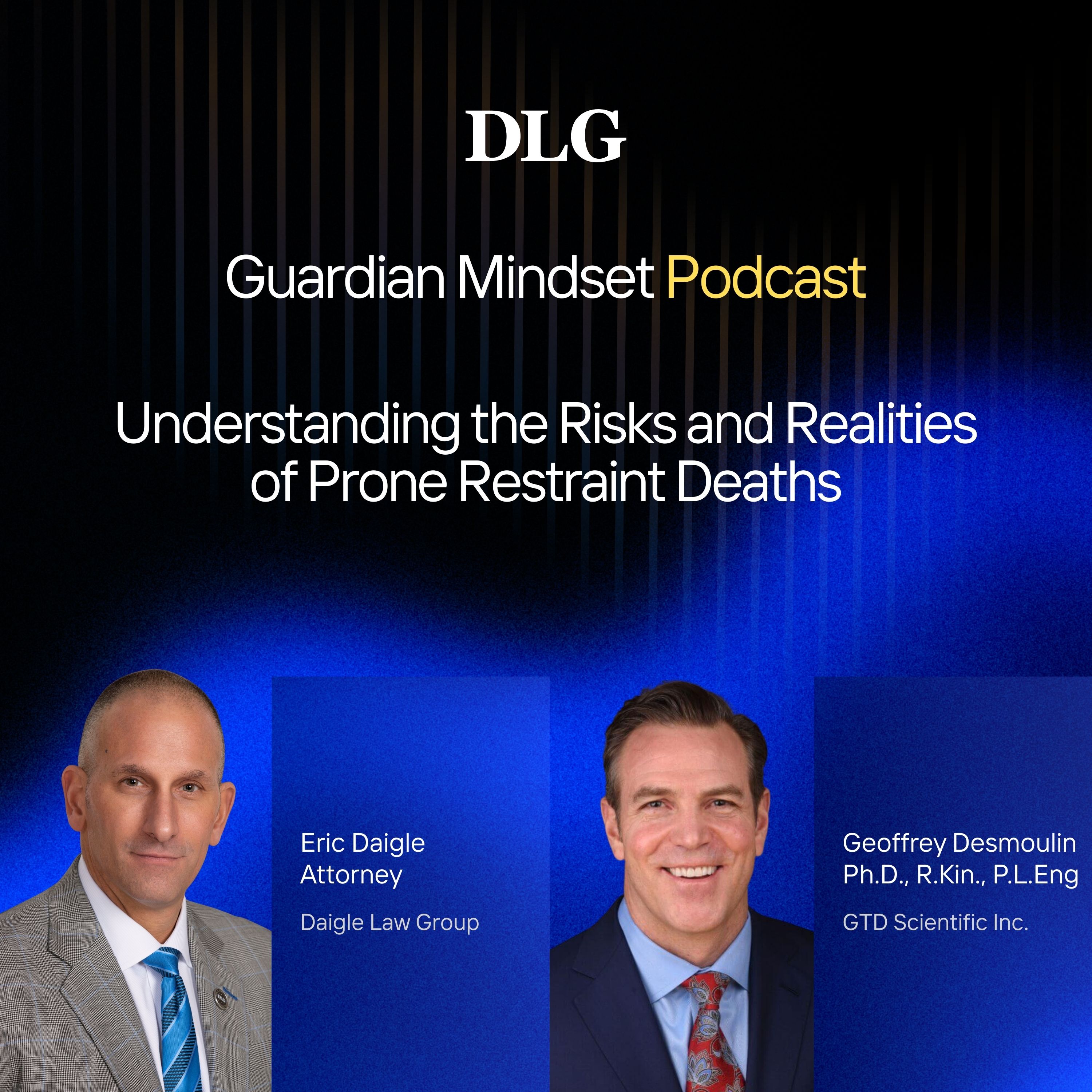
[00:00:00] Speaker A: Hello, everybody. Welcome back to the next episode of the Guardian Mindset podcast. I'm attorney Eric Daigle. I'm happy to be your host today. Where today we're going to talk about beyond positional, the science, the risk factors, the legal reality of prone restraint deaths. This episode is going to examine the science, the law, the real world implications of prone restraint deaths, moving beyond outdated positional asphyxia narratives and into the biomechanics and the physiology of metabolic acidosis. Drawing on current research, case examples, and operational lessons, the discussion explains why certain restrained individuals deteriorate rapidly. That's really what we're looking at here, how risk factors compound and what law enforcement leaders can realistically do now before the science is fully settled. To reduce deaths, liability and trauma to officers and families alike. This episode will challenge the common assumptions. If they're talking, they're breathing. Highlighting emerging legal trends, including circuit court rulings, treating prolonged prone restraint on deadly force, and offers what I think is the most important practical decision points for officers, trainers and policymakers. So with that long introduction, I'd like to introduce Dr. Jeffrey Desmoulin.
Doc, how are you, sir?
[00:01:24] Speaker B: Thank you so much for having me on.
[00:01:27] Speaker A: Dr. Desmoulin is the principal of GTD Scientifics, and he offers biomechanical consulting services on behalf of clients throughout North America and abroad. And we are happy to have Dr. Desmoulin at our Use of Force summit for the past two years. And last year we did video, and this year he was really, really in tune with the issues of positional asphyxia and specifically related to the prone application. And so, Doc, before we dive in here today, why don't you give a little bit about yourself and GTD Scientific, please? Sure.
[00:02:04] Speaker B: My background is a combination of understanding the human body and health. So health sciences had two degrees in kinesiology, which by definition is the study of human movement. But it does cover areas of injury and physiology, which is what I'm tapping into in this particular study. But then I combine that, and the company in general combines that with skills in engineering. And specifically, I'm licensed as a biomedical engineer through a registered regulator here in B.C. called EGBC. And that combination allows me to take engineering principles and apply it to the human body in a very useful way for law enforcement.
[00:02:53] Speaker A: Now, listen, Doc, I first became a fan of yours long before I even known you, because I have serious violence issues. And what that means is that I like the study of violence.
And how did I know that? Years ago when I was plugging through the the 64 episodes of Deadliest Warrior, that sometime you and I would be side by side in the podcast.
[00:03:17] Speaker B: Yeah, that was so much fun and that really did kick off this part of my career. I was just finished off my PhD and I was lucky enough to get selected from, apparently, as the story goes, 1500 different applicants to be the science and engineering host on the Viacom's hit show Deadliest Warrior, which was just a ton of fun.
[00:03:39] Speaker A: I, I was really surprised to see that that thing aired in 32 different languages and available in over 96 million homes in the United States alone. That, that, that, that you infused into this country in a heartbeat, didn't you?
[00:03:54] Speaker B: I really did.
I've spent my share in the United States. The United States has just been fabulous to me and continues to be fabulous to me. And yeah, I just, I can't. We could go on and on and on about that. Actually. I've lived, I went to school there, I've worked there and continue to work there, so love it.
[00:04:15] Speaker A: All right, so because this is a podcast and because we're going to warm everybody up for your one day training program which you're going to do on this hot topic this year at the 2025 Use of Force Summit. You came to us with a, with a new topic. Give us an overview of, of your goal in which you presented to the attendees of the 2025 Use of Force Summit.
[00:04:37] Speaker B: Sure.
Well, as you know, since George Floyd, prone restraint has really conor a new level of scrutiny.
And there was school of thought on, on both sides and there was well meaning advocates that would get in the mix.
There was law perspectives.
The science was really in its infancy and still is really if you think about it. Once we start digging in and we started getting more and more prone restraint related death cases as a company, and that was really how this all started for us is the initial question was, well, what's your expertise? Well, we do biomechanical engineering. Okay, well how can you help us on this? Well, we'll look at the biomechanical factors of what happened here. But as we started to dig into this, we realized just how big this problem actually is. It spreads from, you know, police practices to physiology to biomechanics to medicine and everywhere in between.
And so each case that we got, we just did delve deeper and deeper and deeper into this until we felt like we really had something that was new and decided to publish that. And once we did, and I have to tell you, Eric, the well meaning advocates that were out there, I was kind of putting some of this out there prior to our scientific publication in magazine articles. And I was being openly ridiculed, okay, in public forums. And I was like, look, I'm fine with this debate is healthy, let's talk about this.
But know that a scientific publication is coming and you might have to change your opinion about this based on, you know, what's coming down the pipe. And so once we did publish that and started to talk about it, I, the response was overwhelming. And so, and I know you're a cutting edge guy and I knew if I could at least communicate some of that to your audience that it was going to blow up. And I'm pretty sure that that's exactly the response we got.
[00:06:57] Speaker A: Well, I mean, we all are faced with these issues as we talked about. I have multiple expert witness cases involving these issues. So let's start out with some very basic applications, some foundational questions because a lot of times on the Guardian mindset podcast we're getting basic patrol officers listening to, not they, they. You know, obviously at the Use of Force summit we have, we have commanders, we have chiefs, we have those responsible for training. But let me just ask a general aspect. What do, what do most people, including officers, get wrong about prone restraint deaths?
[00:07:33] Speaker B: I think the number one most damaging belief out there is that weight on the back in the prone position is inconsequential.
For whatever reason, there's very well qualified people out there that are saying that and there are research to support what they're saying. But I have to caveat that, because the caveat is this is the research that shows that that is indeed true is so unrelated to what's happening on the street that it cannot be used as justification for what is happening on the street. And what do I mean by that?
I mean, these subjects are young, healthy, non doped up people that don't necessarily believe their, their life is about to change. They're not being arrested, they're not, you know, they don't have the associated health issues that a chronic drug abuser has, et cetera, et cetera, et cetera, et cetera. So why haven't those studies been done? Well, because the closer we get to reality, the higher the risk for the subject actually is. And so I've got some ideas on.
[00:08:57] Speaker A: How do you do those studies?
[00:08:58] Speaker B: Go ahead, go ahead.
[00:08:59] Speaker A: How do you do those studies? I mean, so up to this point in our life, and I've been doing this job for 30 years, and we all have focused on the term positional asphyxia and that concept of positional Asphyxia, watching your presentation at the summit, that what I got out of that is that it's no longer positional asphyxia is no longer the best explanation for prone deaths. Is that accurate?
[00:09:28] Speaker B: I'm so glad you got that out of it, because that was one of the points I wanted to get across in that presentation. And, yes, I think that term is well outdated now. Asphyxia really talks about the lack of oxygen, and the only way we can actually get that in the body is through airway restriction. And that's not what we're talking about. That's a completely different problem.
And actually, if you look at the physiology, a much less likely problem.
And we can go down that road if you want, but I'm just going to leave it there right now.
[00:10:04] Speaker A: All right, well, let's. Let's talk it this way.
So I do understand, having watched your full presentation and for the purposes of the podcast, I want to just be direct and say, can you explain metabolic acidosis in a way that patrol officers can understand?
The men and women who are going to be handling that, we're going to get into the risk factors, we're going to get into obesity and handcuffing and all of that. But let's just start at a very simple level. What does a patrol officer need to know about metabolic acidosis?
[00:10:40] Speaker B: Hmm.
I think the easiest way to get that across is to understand.
[00:10:51] Speaker A: Now, you notice everybody. I obviously don't give him the questions beforehand, right. Because I'm making him sweat. Like, now. I just want to make sure I.
This is the Guardian mindset podcast. We don't just bring you on and let you walk right through. We're going to make it difficult, right, Doc?
[00:11:08] Speaker B: It is part of my job. It's quite all right. If I can't answer these questions, I will let you know. But boiling it down, I think the most important thing to understand and the easiest thing for a street officer to understand, and I know they understand this intuitively, we breathe in.
What are we doing? We're taking in oxygen.
Everyone gets that.
When I breathe out, what am I doing? I'm exhaling carbon dioxide. I think most people get that the trees help us build up the opposite. Right?
And so those are kind of just common things that people understand.
And I think most people understand that when I use my skeletal muscle, especially during a struggle, byproducts of that skeletal muscle is what is carbon dioxide?
And so along that same line of thinking, I have to off gas that CO2 efficiently.
And so what metabolic acidosis is and what all those risk factors are and whatever else we're going to talk about take decreases the efficiency of taking that carbon dioxide that's being built up in the skeletal muscle and off gassing it through your lungs. And when that, when the inefficiency is too great, then the body starts to fall down this metabolic acidosis cascade.
And when I talk about the buildup of carbon dioxide, what I'm really talking about is physical, and that's what metabolic acidosis is. And we can go into what that relationship is. It's not that difficult. But if you, if you understand the buildup of carbon dioxide means buildup of H plus ions, which decreases ph, then you've understood it and you don't need any other physiology understanding more than that. And it's that buildup of ph that even though the person is talking to you, the, that tells you that the airway is clear, but it doesn't necessarily tell you that the breathing is efficient. And if it's inefficient, we don't know where they are down that metabolic cascade until it's too late.
[00:13:23] Speaker A: I thought it was very interesting in your presentation. As a pool owner, I do understand the ph and the aspect of the concept of I'm growing algae or I'm ripping through pipes, but one of the two things is keeping that ph in the middle.
So let's bring this down to the core aspect of what everyday officers are facing on the street. Responding to individuals in crisis, often with many of the significant risk factors that you're going to talk about, but drug use and overweight, and having already been involved in cardiovascular running or fighting or any of that. So the first aspect, and I think if I underst your presentation completely, and which is reason why I'm supporting you on this, is that the key part that we can do at this point is to clarify to individuals what the risk factors are so that we can identify the risk factors and recognize that this individual is in risk. And so let's start with what would you consider to be the most important risk factor factors that officers can actually recognize on the street?
[00:14:41] Speaker B: Yeah, easy peasy. And I'm glad you brought that up because. And I'm actually glad I'm quite proud that we were able to boil it down to these risk factors because the scientific publication is just simply not enough.
How many of your audience is going to, are going to go read that and actually truly understand it.
And so it's my job as the principal of GTD to not only generate this information, but then Also make it palatable and useful for the people where it really matters.
And I also want to throw out there, Eric, that a big part of doing this is not to tell officers what to do, not to tell agencies what to do, but to give them the tools so that they can make the changes that they need to make that are right and specific to their agency. And I think the risk factors is a perfect balance between providing them with the scientific information and basic tools that they can use to make those decisions. So here we go. The first one, and probably, I mean there's so many, I can't say which one's most priority, but the one that seems really applicable to prone restraint is obesity. And there are several of them. We can go through a bunch of them. I don't know how deep you want to go on each one of them.
[00:16:07] Speaker A: But obesity, I think if we hit those, if we just hit the categories, and that means they got to come back more for you just to get the full. But this way, for me, and we've been teaching, for me, this is an amazing concept because I started out in the use ofForce Arena 25 years ago talking about excited delirium in the factor of risk factors. And then we move to all of the drama that occurred and now we're at now the iacp. We recently produced a. I was on the committee that produced a new policy on acute behavioral emergencies. And it's still the same issue. It is, it's still that the average officer just needs to know, hey, hey, if this guy is obese and this guy is possible drug use and this guy is on his stomach, I should probably call medical.
That's really what we want to boil it down to, its core concept.
[00:17:12] Speaker B: Yeah, I would agree. And I think that excited delirium was, I think, the tip of the iceberg. And now we've got is a set of risk factors that the average police officer without, with minimal training can recognize on the street that are directly linked to physiology and this newer concept of metabolic acidosis. But to go through the eight risk factors that I talk about, one is obesity, the other one you mentioned already, drugs, hard surfaces, and that's just kind of a, probably a non intuitive one. If you can get them on grass or if there's grass available. I'm not asking anyone to carry any more gizmos. I mean if anyone's weighed down with gizmos, it's, it's law enforcement. But if there is grass available, it is remarkable what 2 millimeters of compliance in the ground will do. For someone who's having trouble breathing. Anxiety, anxiety. Another risk factor. Struggling is kind of an obvious one. If you listen to the, the skeletal, you know, the explanation of how skeletal muscle exertion builds up carbon dioxide. The overall time it takes you to restrain somebody and get them into a more natural breathing posture.
Downward force is a big one. And then this newer concept where there is zero research so far is immobilization. And what do I mean by that is just the.
If somebody is.
It's usually seen like the way we're defining that in the paper is multiple officers that prevent any amount of movement from subjects that has been already determined to be resisting.
Now why they continue to resist could be a number of reasons. One of them that we're just throwing out there is could it be that these people are trying to get into different positions that make it easier for them to breathe and that's being interpreted as resistance, just throwing it out there as something for law enforcement to consider as, as, as they go down this road.
[00:19:34] Speaker A: So as you let's go, let's walk through a quick and dirty aspect of individual meets a lot of risk factors is being restrained. Whether it's a person in crisis or an individual who's committed a crime, it really doesn't matter at that point. But then the things that I want to focus on and which I really liked from your presentation is the two things that I want to give to the street officer could be listening to this podcast is number one was time.
And you really talked about time as the critical variable. And then also the recovery position.
I've seen a lot of people push back against the recovery position like it's an officer's way of overcompensating for a situation. But I do recommend to officers that once we can get them off, get them off their chest and get them into a sit up position or a recovery position is valuable. So let's break this down. Let's start with time. Why is time such a critical variable even in situations where force may be reasonable for the purposes of a lawful apprehension?
[00:20:51] Speaker B: Yeah, and don't get me wrong, Eric, I am not saying that prone restraint is not useful or effective or should never be used again. I don't think courts are saying that either. And you're the lawyer.
[00:21:04] Speaker A: No, I don't think so either. I think they recognize that it is what it is. And that is when defensive tactics in its basic application is point restraint.
And an individual on the ground is more restrained than an individual who is standing. And I think that's where the challenges start to increase. But what we cannot account for is the fact that the integration of people in crisis, and you can be in crisis in many different forms, and the medical issues associated with the people in crisis, how that has led to so many deaths over the past few decades.
[00:21:49] Speaker B: Yeah, exactly. And seemingly unexplainable.
And. And with every opinion under the sun to go along with it as well.
So the time aspect, though, to get more specific to that answer is again, no one's, no one's preventing you from doing your job.
Where we have a problem is if they are on that road to metabolic acidosis. We don't know. Okay. Where they are along that. That road.
And so if we can control, the quicker that we can control them, get them in restraints and get them into a position.
And I would agree with you, I think recovery positions kind of overblown as being the. The be all and end all as to way to position somebody. But just looking at the breathing mechanics I went through in. And I won't divulge it here, or at least in. In the same detail because I think, you know, a picture is a thousand words, and I don't have that. That, you know, privilege on in this platform. But your. Your lungs expand in various ways. And while the primary way is, let me say this, that the recovery position will assist breathing in the primary movement of the lungs during breathing, but they don't reduce all of it because there's different movements of the lungs in which the recovery position will also restrict. So it's better, but not perfect. And so what's even better than the recovery position is where they're sitting up. That we know is by far the best position. And, and if I were.
[00:23:42] Speaker A: Go ahead, let me interrupt you there because I would consider when I'm teaching officers the recovery position, I am teaching them sit up. So let's make sure we're using words that we both agree on.
What are you considering as the recovery position?
[00:23:56] Speaker B: Recovery would be one side or the other.
[00:24:00] Speaker A: Okay.
[00:24:00] Speaker B: Rather than prom. That's my interpretation of recovery position.
I come from my EMT days. But sitting up would be very specific. You know, where. Where the torso is vertical.
And the only thing better than. Than that would be torso vertical with hands in front of the chest, not behind the back.
Again, I don't know if that's something that's going to be right for your agency. I'm not suggesting. But if you're worried about this, that's something for consideration.
And just on that point, you know, when. When do we Call ems.
[00:24:39] Speaker A: Well, I mean, we train right away. That, that's, that's, that's where I think your training and my training go. Hand in hand is those factors that you've identified should lead to. And we, you and I both know the Ninth Circuit has issued multiple decisions that are differentiated by EMS being on scene versus not being on scene. So based on my interpretation of the 9th Circuit cases, we'll the 10th Circuits out of this right now. But just my 9th Circuit interpretation, which I can't believe I'm actually saying this, but the ninth Circuit interpretation seems to say very clearly medical should be an automatic response. And by the way, we've been teaching that for 20 years in excited delirium because we knew that the time limitations, once the individual, once their blood, once their core temperature got so high that they were automatically going to pass out, and once that pass out occurred, bringing them back was proven to be almost impossible. And so back at the early days, we would say, hey, medical on scene. Medical on scene. Medical on scene. And I think that's what you're recommending too, right?
[00:25:57] Speaker B: Well, see, I'm indifferent to it because that's really not my area. That's a procedures thing at the LE and judicial and agency level that doesn't involve me. But, but here's, here's. I ran that question by someone local, and I said, when would you call ems? Because one of the chief, James Drace, his agency now will call EMS when the subject continues to struggle against restraints. So it's business as usual as a police officer until they're in restraints, and if that subject continues to struggle against restraints, they call ems. That's the trigger. That's the decision tree for them.
And I ran that question by somebody local, and they said there's no way that would work in Vancouver because EMS is already taxed. Now you're asking them to go to respond to every, you know, hooligan that's struggling against restraints. He says they wouldn't arrive for 45 minutes.
[00:26:55] Speaker A: Okay, let's pick up on that. That's a hot topic right there. Which I want to go to the next level for the officers.
There is a difference between handcuffing and not handcuffing in your world. That's what I, that's what I took from your presentation. And so I want to give you an opportunity for the everyday officer who might be listening to this podcast.
Why does continuing to struggle after handcuffing matter so much in our analysis?
[00:27:24] Speaker B: Okay, well, let's look at the risk factors and One risk factor I did not indicate, and I may add that in future, depending on where the research goes and, and what we get funding for.
[00:27:40] Speaker A: But, you know, isn't that always the way.
[00:27:42] Speaker B: Yeah, yeah.
But there is a paper. Campbell 2 2023.
This is going to be a pain for pivotal paper, I guarantee it. That looks at lung function and specifically functional residual capacity. And I know it's a fancy word, but for the street officers that are on that are listening to this, it just means the amount of air left in your lung after a normal expiration. Okay?
[00:28:16] Speaker A: Okay.
[00:28:16] Speaker B: And you can imagine that if that residual capacity, the amount of air that's left over after a natural expiration starts to decrease, you can just intuitively know that's probably not a good thing. Like we're getting closer and closer to lung collapse. Right. Okay. So what Campbell 2023 found was that when hands are behind the back and weight is on the back.
[00:28:43] Speaker A: That that.
[00:28:43] Speaker B: Functional residual capacity continues to decline. Okay. Over. Over five minutes that it was measured in that study. They'd never been shown before.
So what we've got is during struggle and after struggle, we have this inefficiency to breathe appropriately if the hands are behind the back. So now am I recommending that you take the handcuffs off and move it to the front?
No, that's up to you. As an agency, I know that Chief James Drees does instruct that.
[00:29:16] Speaker A: However.
[00:29:18] Speaker B: According to Campbell 2023, it would assist because the comparative group to that was that hands were by the side and they continued to be prone and they did not have that decreasing functional residual capacity. And I know that's fancy words.
[00:29:36] Speaker A: All right, yeah, let me make that English. Are you saying that you can breathe better with hands in front of you than behind you?
[00:29:42] Speaker B: Essentially, that is it.
[00:29:44] Speaker A: All right, That's. That's what you need me for, Doc. I'm easy.
I'm straightforward, like. But now the challenge, and I'm going to tell you, as you know, because you talk to multiple, many law enforcement people in this analysis, is that that's not how we, by the time we're in a full out attempt to restrain an individual that has either, you know, that may be in crisis in some form or another, usually in form of narcotics consumption. And now it's in, by the way, fighting significantly to, with capacity and with ability because of strength that we looked at in the prior excited delirium application. You know, that is going to be a big discussion point of handcuffing. I mean, should, you know, maybe what you're saying Is in these type of situations, belly chains are better than handcuffs behind your back. Is it basically something that keeps the hands to the side or the front is something that we should be looking into.
[00:30:53] Speaker B: If you're talking from a physiology standpoint, I have to answer yes, but I can't recommend it, you know, as from a police operations standpoint.
[00:31:03] Speaker A: No, no. I mean, you do a great job of, of. One of the things that I, I think is very important that we should talk about here is that you and I both recognize that neither of us want to be responsible for officers being placed in situations where they can be harmed.
And really what we're looking for is trying to balance the protection of officers with the challenges that come after an individual dies in custody.
And like both of us, we have extensive cases on our desks involving individuals die in custody. And that gives us an opportunity to get to the next point here, which I think might be our biggest part, is that, number one, would you agree that the research is still in its infancy stages?
[00:31:48] Speaker B: I think infancy is a good way to.
To state it.
And the reason is, is because it's all piecemeal right now, and we're still kind of coming out of this idea from 10 years ago, and which is why courts are still using the term positional asphyxia, while every now and again you'll still hear excited delirium, and no one can really point to a study that can actually replicate what's happening on the street.
I have a bunch of ideas on how we go about that, but it's going to take teamwork. And let's face it, doctors don't really want to talk to scientists. Scientists are kind of in their own little world, as you know, Eric, and cops are traditional.
And so how do we get this team together? And that's really what it's going to take. And what's going to be the protocol and who's going to run it. That's really the discussion that needs to happen.
We're currently in discussions with the right people, but what comes of it, I have no idea.
[00:32:57] Speaker A: Well, I got to tell you that my experience over two decades has been that you said a couple of things that were very valuable during your presentation, which is that police executives, if you're listening to this from a police executive area, it's time to get on the phone with your medical directors and with your fire.
You may recall, in Illinois About a decade, 15 years ago, we talked about the swarm technique and the application of teaching both fire and ambulance and law enforcement to respond together Restraining limbs versus the core body portion.
And we actually, in the early days of the Use of Force summit, had brought individuals in to talk about training the swarm. And I actually have some clients that brought fire into their training because they didn't have enough law enforcement officers responding to incidents to really focus on the correctional aspect of securing limbs versus the corps center aspect. So the two questions that I want to wrap this up with, the first one is just a general, which might be a little difficult for you, but if you were, as you start to look at this aspect, what have you found that needs to be addressed in the police training nationwide? And if you could have the ability to insert certain things into police training today, where do you think that energy should be spent to address this issue?
[00:34:35] Speaker B: Reducing the amount of time it takes officers to properly restrain a subject? I think if we can do that, we there, that's a big win because as soon as they're in restraints, we can put them in positions that will reduce the likelihood of them dropping down that cascade we talked about.
[00:34:59] Speaker A: And if you were going to give some advice to a police chief, like the chiefs that you've worked with across the country, United States and Canada, what conversations would you want them to have with their medical directors, EMS response or fire, to address these issues? What would be. If you were their consultant, what direction would you push them towards?
[00:35:27] Speaker B: I would say first look at how your systems are integrating and.
[00:35:35] Speaker A: See if.
[00:35:35] Speaker B: There'S ways that you can make them more efficient. That would be number one. And that's kind of off the top of my head, but as a scientist, we need to know what's going on and then we can properly address it. And so instead of taking this shotgun approach, which I feel the industry is going, the, The Swedish study, we don't have to get into that, but the Swedish study, I, I really do credit them for trying to get data from the street and we don't have that. And, and there's all sorts of issues with the Swedish study, by the way, that make it.
[00:36:15] Speaker A: I do like it, though.
[00:36:16] Speaker B: Sorry.
[00:36:17] Speaker A: I do like it. I think, I think it, it actually touched on. I put it out on LinkedIn and the Today, which is the day of our.
But that It's a recent 2024, 2025 study that looks at multiple years. And I think it.
If you look at things the way I like to look at these things are what can we take from them?
What can we extract from other people's work? Just like your own. Like in my world, in the policy and operational side, you Know, we're always looking for that little nugget of information to be able to give that guidance. So I think that's what I thought was very valuable.
[00:36:57] Speaker B: Yeah. And what I liked about this Swedish study is if you look at their model of how these events occur, they're very similar to the risk factors that we highlight. So. And the two papers went through the review system at the same time and independently. So, you know, we've got two groups of scientists that are kind of coming up with, with a similar model on other sides of the world.
And that, that right there just adds a huge credibility to, to both of what, what we're finding. But I still say there's room to figure out what's happening on the street. And I have some ideas on how to do that. I just need somebody to back it. And of course, you know, a whole medical system and an EMS people to.
[00:37:43] Speaker A: Get on board and just a few things, that's all.
[00:37:46] Speaker B: Yeah, exactly. So we're having those conversations, but you know, how it rolls out, I have no idea. But, but we need more information. And then once we have that information, we can prioritize as to what we actually study. Because if we study what's happening on the street, we're just going to end up getting, you know, ethical rejections.
[00:38:05] Speaker A: That's true. So what I do want to put on a point here is so here at Dago Law Group, you know, we're happy to have Dr. Desmond as our, one of our instructors, keynote instructors for the use of Summit. And we will be hoping to release in the next couple of months a one day training program on this. But one thing that's more important to us is that I really like the articulation that use of force involves science.
And one of the things that frustrates me as an expert, and probably you too, Jeff, is that, you know, there is science to this application, whether we like it or not, whether it's human factors with Dr. Paul Taylor and Dr. Lewinsky or the biometric application with yourself in the legal analysis. And the one thing we're happy about is that we all are going to partner together for one very specific reason, is that we're going to bring, all of us are going to bring our skill sets to this in the hopes that we can continue to find a way forward. And I like the way you ended your presentation with, you know, listen, we don't have all the answers. We just, we just kind of look at these things, learn from them. And the question on the table is we gotta do something so how do we find our way forward? So I'll give you an opportunity if you want to. One last thoughts as we wrap this up and hope to have you back definitely in the future as we continue to follow up on this research.
[00:39:35] Speaker B: Yeah, I think the only real take home that I'd love to have stick with your audience is increase the time or, sorry, decrease the time necessary to get people in restraints and get away from this notion that weight on the back is inconsequential. If you take those two things away from this, then I think we've done our job.
And Eric, I really look forward to working with you and the rest of your team on this.
[00:40:02] Speaker A: Definitely give a shout out to your Science of Violence class.
I do think that for those of you that are very focused on use of force analysis and investigation, that science is a very important analysis.
[00:40:18] Speaker B: Jeff yeah, there's a 90 minute presentation. It's just a recorded webinar that you can purchase off of our website and it will give you all the details behind the science of those risk factors that we talked about.
[00:40:33] Speaker A: Awesome. Well, you're, you're going to start out the 2026 year with a bang and we're happy to have you and I hope that our paths cross again soon. And I thank you for your time and taking some time out of your schedule to, to really get down and dirty with the, with the, those that will listen to this podcast anytime.
[00:40:55] Speaker B: Eric, thanks for having me.
[00:40:57] Speaker A: And so everybody, this wraps up this episode of the Guardian Mindset podcast and I will end this one as I do every single one. Help those that need your help, protect those who need your protection, and most importantly, keep yourself and others safe. Thank you. Be well.